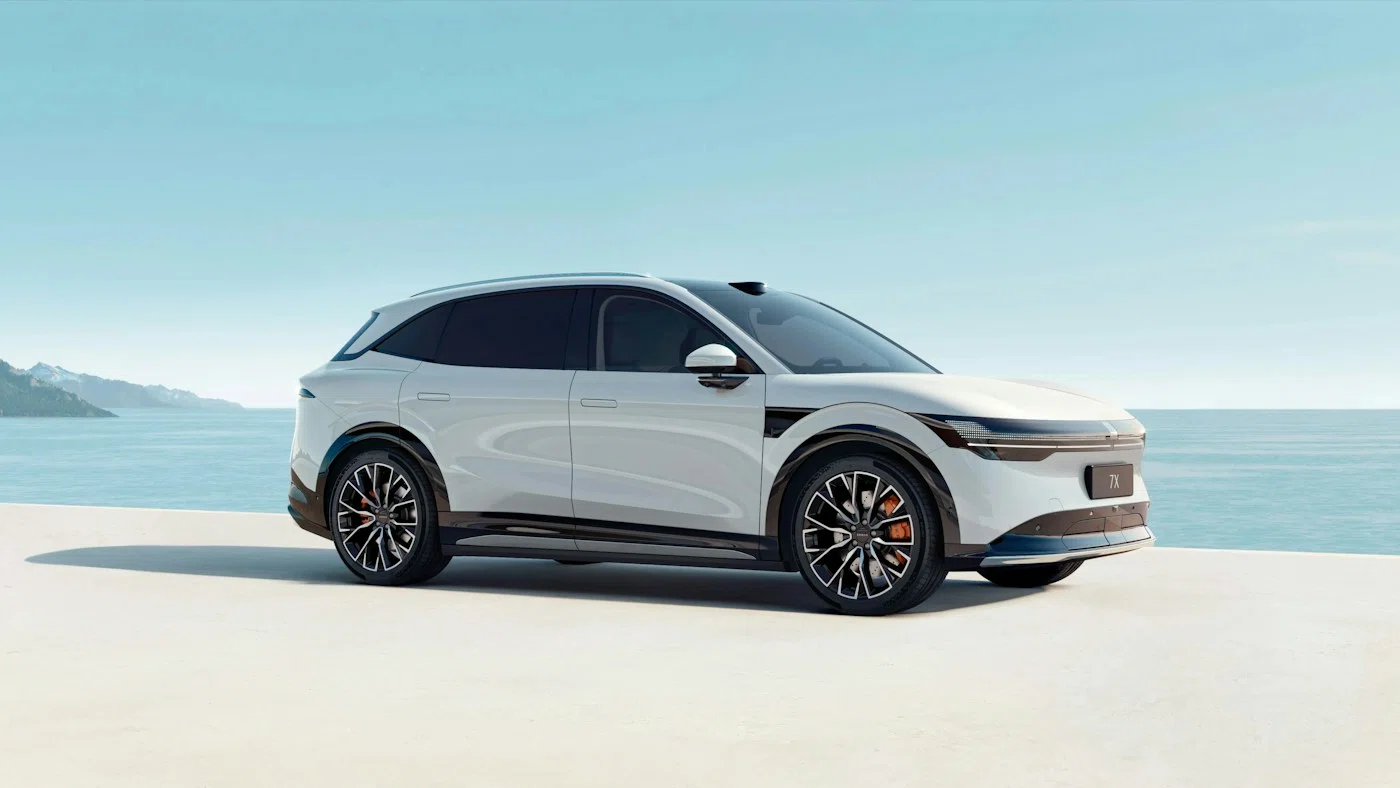
Manufacturer reference image. Controls and equipment vary by vehicle.
Sources checked:
Scope checked: 26 October 2026. China battery examples use the official configuration snapshots retrieved on 25 October 2026. Match the original market, model year, hardware and software before applying a procedure.
Start with the inlet, not the badge
A ZEEKR 001, X or 7X built for one market need not have the same charging interface as a vehicle with the same name sold elsewhere. Photograph the open charging inlet, its labels and the charging-equipment rating plate. Add the model year, original sales market and any documented conversion. A Chinese manufacturing VIN prefix alone does not identify the charging specification.
The Macao transport authority’s approval for one 2025 7X RWD 75 kWh version records GB/T AC and DC standards. This is a concrete example, not proof that every 7X uses GB/T. Treat an overseas CCS2 car and a China-specification car as separate compatibility checks.
AC and DC require different checks
- AC charging: the car’s onboard charger converts the incoming supply. Check inlet standard, phase support, voltage and current; a high-power wallbox does not override the onboard limit.
- DC charging: the station supplies DC to the traction battery under electronic control. Check both connector and communication compatibility, together with operating voltage and current.
- A Type 2 AC cable, a CCS2 DC connector and a GB/T AC or DC connector are not interchangeable products. Read both ends of the proposed cable or converter.
Why a plug-shaped adapter may still fail
An adapter must do more than fit. Where charging protocols differ, the system may need active communication conversion and appropriate protective functions. CharIN explains that mechanical adaptation alone cannot bridge incompatible communication systems. Never assume that an inexpensive AC adapter also works at a DC fast charger.
Ask the adapter manufacturer to confirm your exact car, charger type and direction of conversion in writing. Require its voltage/current limits, operating-temperature range, instructions, approvals applicable at your destination and a clear support route. A marketplace description saying ‘for ZEEKR’ is insufficient.
A practical compatibility checklist
- Record the vehicle inlet and the station’s actual output connector. A station logo or map marker is not a connector specification.
- Confirm whether the session is AC or DC, then match the vehicle, cable/converter and station ratings.
- Check whether the charging operator permits the proposed adapter and whether its payment or authentication method is available to you.
- Inspect the equipment without touching contacts. Do not use damaged housings, burnt pins, wet or contaminated contact surfaces, or a chain of adapters.
- Follow the equipment’s connection sequence. Confirm the car reports an active session and plausible power before leaving it unattended.
If charging does not start
Separate authentication from compatibility: ‘payment refused’ is different from ‘vehicle communication failed’. Record the station ID, displayed error, state of charge and adapter model. If equipment appears normal, try a known-compatible outlet or another operator rather than repeatedly reconnecting a failed converter.
For heat, a burning smell, visible damage or a persistent high-voltage warning, stop the session using the normal controls and seek qualified assistance. Do not force a locked connector, open an adapter or alter charging pins. A second failed session does not justify bypassing protection.
What changes between models and versions
For early and refreshed 001s, verify the actual inlet and onboard-charger specification; do not carry forward an old charging limit. For 7X, 007 and 007GT, a high-voltage platform claim does not establish a particular converter’s support. For 009, X and MIX, use the same inlet-and-rating method rather than buying accessories by body style.
For plug-in-hybrid 8X and 9X, also verify the vehicle’s own AC/DC capability and charge limits. A battery-electric 7X demonstration cannot establish compatibility for either hybrid. Keep photos and the first successful charging record with the car’s handover documents.
Sources and version references
- CharIN — charging compatibility
- Macao transport authority — 2025 7X RWD 75 kWh
- ZEEKR China configuration 7X — snapshot: 25 October 2026
Continue reading
- ZEEKR batteries: LFP, NMC, charge limits and interpreting range
- ZEEKR winter range: preconditioning and planning with real consumption
- ZEEKR app not connecting: account, Bluetooth and mobile-data checks
Publisher and source basis
Published by Wenzhou Yutai Import and Export Co., Ltd. (YUTAI), the independent exporter operating CHINA ZEEKR AUTO. This is not the manufacturer’s official website. Manufacturer specifications and regional examples are reference information, not a guarantee of overseas compatibility or warranty.
About the exporterRelated model reference pages
China-market reference. Match the original market, model year and actual equipment before applying specifications or instructions.