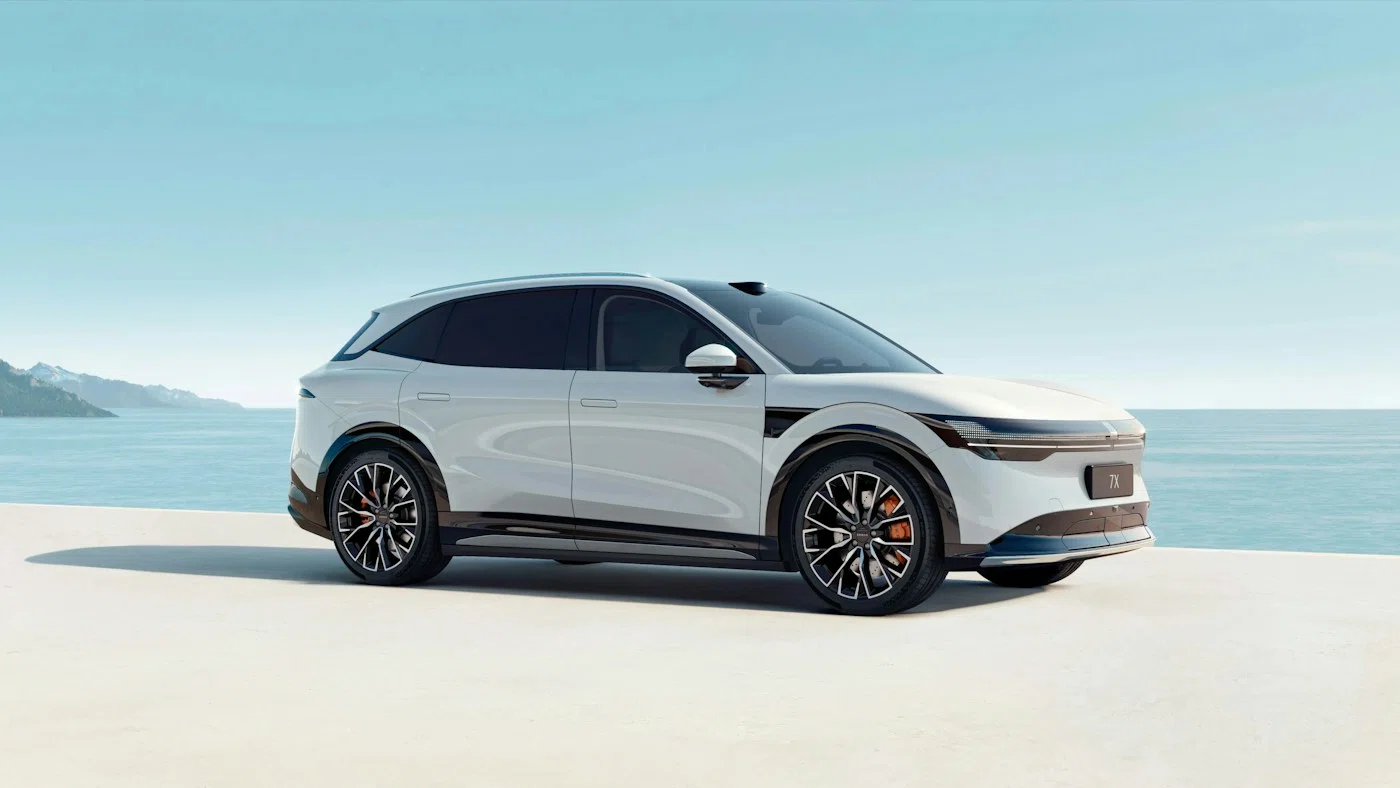
Manufacturer reference image. Controls and equipment vary by vehicle.
Sources checked:
Scope checked: 26 October 2026. China battery examples use the official configuration snapshots retrieved on 25 October 2026. Match the original market, model year, hardware and software before applying a procedure.
Start with the car and parking space
A useful home charger replaces the energy used on an ordinary day while the car is parked. Before ordering equipment, identify the original sales market, model year, inlet and onboard AC charging specification. A Chinese 7X and an overseas 7X can share a badge without sharing charging hardware. China-market 8X and 9X are plug-in hybrids in our configuration reference; do not apply a battery-electric model’s charging figures to them.
- Photograph the inlet and vehicle identification label; keep the VIN private when posting online.
- Record parking distance, cable route, weather exposure and whether the space is shared.
Ask an electrician for a site assessment
Have a locally qualified electrician assess supply capacity, earthing, protective devices, cable routing and any approval required for shared parking. Ask for a written proposal covering equipment, installation, testing and documentation. A charger advertised as 22 kW cannot make a car accept 22 kW AC, and a single-phase supply cannot provide a three-phase rating simply through a different cable. Installation details must follow local requirements.
- Ask whether dynamic load management is needed when cooking, heating or cooling equipment runs.
- Confirm the usable continuous output at your parking space, rather than the product’s headline rating.
Estimate overnight energy, not a full battery every day
For planning only, driving 60 km at an observed 20 kWh/100 km uses about 12 kWh. At a sustained 3 kW delivered into the battery, replacing that energy takes roughly four hours. Household consumption will be higher because charging has losses; heating or cooling can add demand. This is an arithmetic example, not a measured consumption or charging specification for any ZEEKR.
- Use your own recent consumption and leave spare charging time for weather and unexpected trips.
- Compare electricity meter energy with charger energy consistently; neither is automatically the energy stored in the battery.
Commission the installation with your own car
Arrange the first charging test while the installer can assist. Start with an intact, dry connector and follow the equipment instructions for connecting and authorising the session. Confirm that the car actually shows charging, then stop and disconnect through the normal controls. The correct charging limit depends on the vehicle’s battery guidance; the separate battery guide explains why one percentage does not fit every pack.
- Check a complete start–charge–stop–unlock cycle and retain the test record.
- Confirm the cable reaches without tension, crossing a walkway or resting against a sharp edge.
Choose one schedule controller
If both the wallbox and car have timers, overlapping rules can leave the vehicle waiting all night. Initially use one scheduler, check the vehicle’s clock and departure requirement, and test a short session before relying on an overnight tariff. A cloud app reporting an old charge level is not proof of a charging failure: compare the in-car display and wallbox record before changing settings.
- Set an alarm for the first scheduled session and verify that energy was delivered.
- Record the tariff window and required departure charge; keep a fallback for an urgent journey.
Build a repeatable weekly check
Inspect the plug and visible cable before use. Stop using equipment with damage, unusual heating, burning smell or repeated protective-device trips and arrange professional assessment. Do not keep resetting a fault or improvise with extension leads and travel adaptors. Store the connector as its maker specifies and keep installation and equipment records together so a future technician can understand the system.
- Check that scheduled charging still works after a power cut or settings change.
- For a session that fails, use the charging-fault guide and record the wallbox message before retrying.
Sources and version references
- Australian Government — charging an EV
- ENERGY STAR — home charging equipment
- ZEEKR China configuration 7X — snapshot: 25 October 2026
- ZEEKR China configuration 9X — snapshot: 25 October 2026
- ZEEKR China configuration 8X — snapshot: 25 October 2026
Continue reading
- ZEEKR charging ports: GB/T, CCS2 and choosing an adapter
- ZEEKR batteries: LFP, NMC, charge limits and interpreting range
- ZEEKR not charging or plug locked: a diagnostic checklist